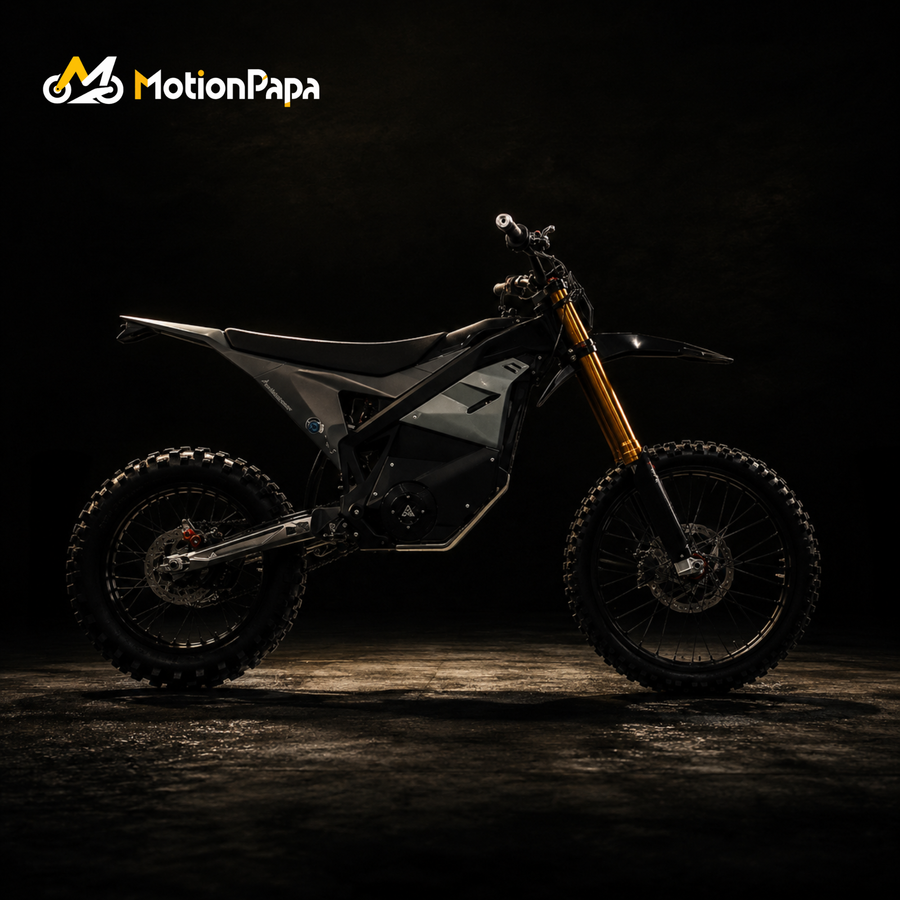
A removable dirt e-moto battery changes where you may be able to charge and store the energy pack; it does not automatically make the battery light, interchangeable, travel-ready, or safe to charge anywhere. Treat removal as an ownership workflow: confirm the pack-only weight, official removal sequence, correct charger, secure storage position, transport rules, and exact replacement compatibility.
Last updated: September 12, 2026. For this guide, we checked the live MotionPapa product records, Shopify images, native variants, published motion_papa metafields, and support terms for Zmey LA25 and Zmey RS LA35. The records confirm removable battery architecture, but they do not publish pack-only weight or a step-by-step removal procedure.
Who benefits from a removable dirt e-moto battery?
This route works best for a rider with ground-level vehicle storage but no suitable outlet beside the complete machine. A removable pack may let the charging location and parking location be planned separately, provided the product instructions permit removal and the rider has a dry, stable, access-controlled place that meets the manufacturer’s charging guidance.
It is not a shortcut for frequent stair carrying, passenger-air travel, improvised charging, or sharing packs between models. Both current Zmey listings show a 91.5 kg complete vehicle, while neither listing gives the battery’s separate mass. “Removable” therefore describes the architecture; it does not prove that one person can lift or carry the pack comfortably.
What does removable actually change?
A removable battery separates some ownership decisions that are fixed together on an integrated machine. Parking can be evaluated by vehicle size and security, while charging can be evaluated by outlet access, ventilation, supervision, temperature, and exit clearance. That flexibility matters only when the removal, carrying, connector, locking, and reconnection steps are documented for the exact model.
| Ownership question | What removal may change | What it does not prove |
|---|---|---|
| Charging access | The pack may charge away from the complete vehicle when approved instructions allow it. | That every room, outlet, extension lead, or charger is suitable. |
| Storage | Vehicle and battery locations can be planned separately. | That the pack is light, child-safe, weatherproof, or secure without a dedicated location. |
| Transport | A pack may be secured separately when rules and packaging permit. | That it is ordinary luggage or exempt from carrier and hazardous-material rules. |
| Replacement | A damaged or end-of-life pack can be identified as a separate component. | That another voltage, connector, case, or “universal” pack is compatible. |
In simple terms, removal creates options, not permissions. The current MotionPapa record verifies that Zmey LA25 and LA35 use removable Samsung 50S NCM battery architecture. It does not verify pack interchangeability, off-bike charger procedure, connector cycle life, carrying handle capacity, water resistance, or the individual battery weight.
How should you plan the charging location?
Start with the exact product instructions and supplied or manufacturer-recommended charger. The U.S. Consumer Product Safety Commission’s 2025–2026 micromobility guidance says to remain present while charging, never charge while sleeping or away from home, follow the manufacturer’s directions, unplug when finished, and avoid unapproved replacement packs or reworked cells.
The National Fire Protection Association’s battery safety guidance adds practical location checks: keep batteries away from exit doors, flammable items, liquids, direct sun, and hot vehicles. Stop using a pack that develops unusual odor, excess heat, shape or color changes, leaking, smoke, or failure to hold charge.
Do not infer a safe removal sequence from the product photograph. The live MotionPapa support terms say not to open a battery or electrical system unless qualified support specifically instructs it. Before ordering, ask for the LA25 or LA35 removal, locking, connector inspection, off-bike charging, and reconnection steps in writing if those details decide your route.
How do the verified Zmey battery records differ?
Both live products list 4,320 Wh of nominal energy, removable Samsung 50S NCM architecture, a 2.5-hour charging record from 20% to 80%, and 91.5 kg complete-vehicle weight. LA25 lists 72 V 60 Ah; LA35 lists 96 V 45 Ah. Those numbers identify different electrical architectures, not interchangeable packs or equal real-world outcomes.
This article deliberately does not turn those battery figures into a complete LA25-versus-LA35 performance verdict. MotionPapa has not published pack-only weights, matched energy-use tests, removal times, or cross-compatibility. Listed range and charging time can vary with rider, load, terrain, temperature, maintenance, battery condition, charging environment, and riding mode.
Does removal make transport simple?
No. The Federal Aviation Administration’s 2026 PackSafe guidance says a lithium-ion recreational vehicle battery above 160 Wh is prohibited in carry-on and checked passenger baggage. Both current Zmey records list 4,320 Wh, so removing the pack does not turn either model into ordinary airline luggage.
Ask the carrier and qualified shipper about the exact battery, energy rating, condition, packaging, terminal protection, route, and mode of transport before moving it commercially. If the pack is damaged, defective, or recalled, stop ordinary transport planning and obtain model-specific direction. Removal is useful for access; it is not a waiver from transport rules.
What are the storage and end-of-life boundaries?
The U.S. Environmental Protection Agency’s 2026 lithium-ion battery guidance recommends room-temperature storage and avoiding long exposure to extreme heat or cold. It also says lithium-ion batteries should not enter household trash or curbside recycling; use a suitable collection or household hazardous-waste route and follow local requirements.
A detachable pack also needs physical protection from impact, crushing, conductive objects, moisture, unauthorized access, and unstable shelving. The current Zmey records do not establish a universal long-term state-of-charge target, so this guide will not invent one. Follow the exact product instructions or obtain written MotionPapa support guidance for seasonal storage and inactivity.
Which removable-battery route is the best fit?
Best-for verdict: choose a removable-battery dirt e-moto only when separate charging access solves a real parking problem and the pack-handling procedure is realistic for the people and space involved. Avoid making removal the deciding feature when pack weight, off-bike charging instructions, secure storage, or transport requirements remain unresolved.
The Zmey LA25 is the primary product path for a rider already considering its verified 72 V 60 Ah, 4,320 Wh removable-battery architecture and 91.5 kg complete ownership footprint. It is not recommended as a lightweight carry option, and this guide does not claim it is universally better than LA35. Compare the Beasts Series if the vehicle family is still open.
Use the Electric Ride Buying Guide before choosing a vehicle, and read the related dirt e-moto wheel-size guide if transport and fit matter alongside charging. Boring can walk; the battery routine still has to work every ordinary day.
Plan the charging spot before choosing Zmey LA25
If the LA25’s verified 72 V 60 Ah removable battery, 4,320 Wh energy record, 2.5-hour listed 20%–80% charging window, and complete vehicle size fit your route, inspect the live images and current fields on the Zmey LA25 product page. Ask MotionPapa support for the missing pack-only weight and exact removal/off-bike charging instructions before checkout when those facts decide ownership.