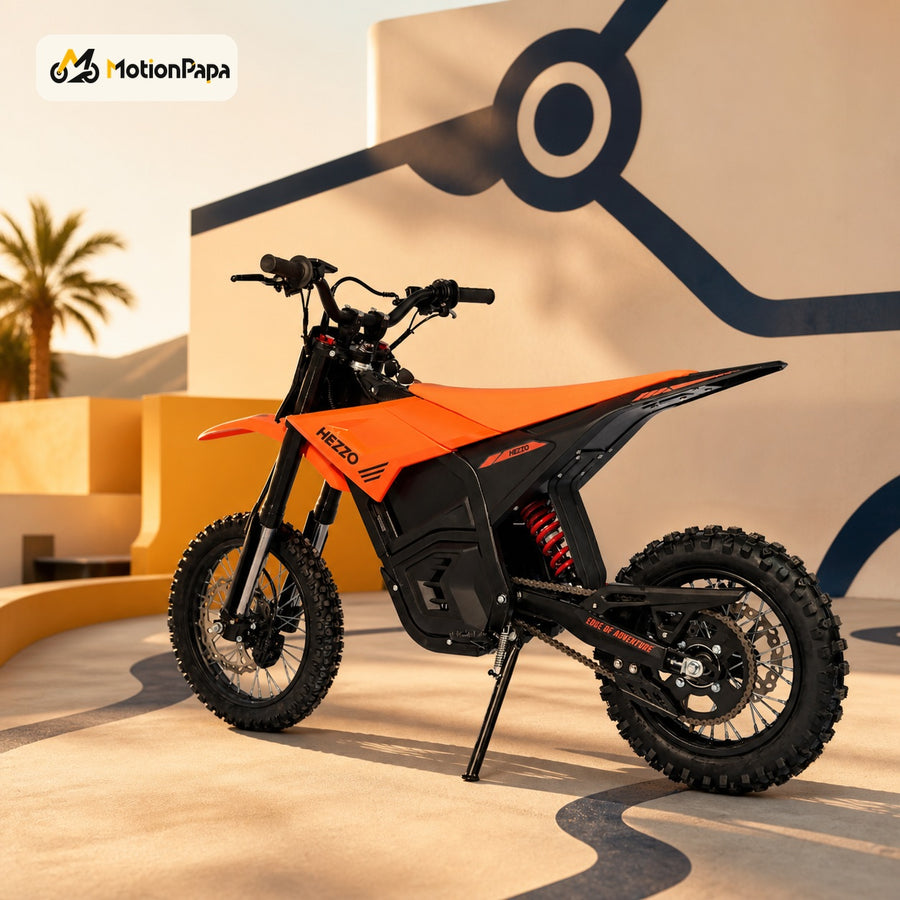
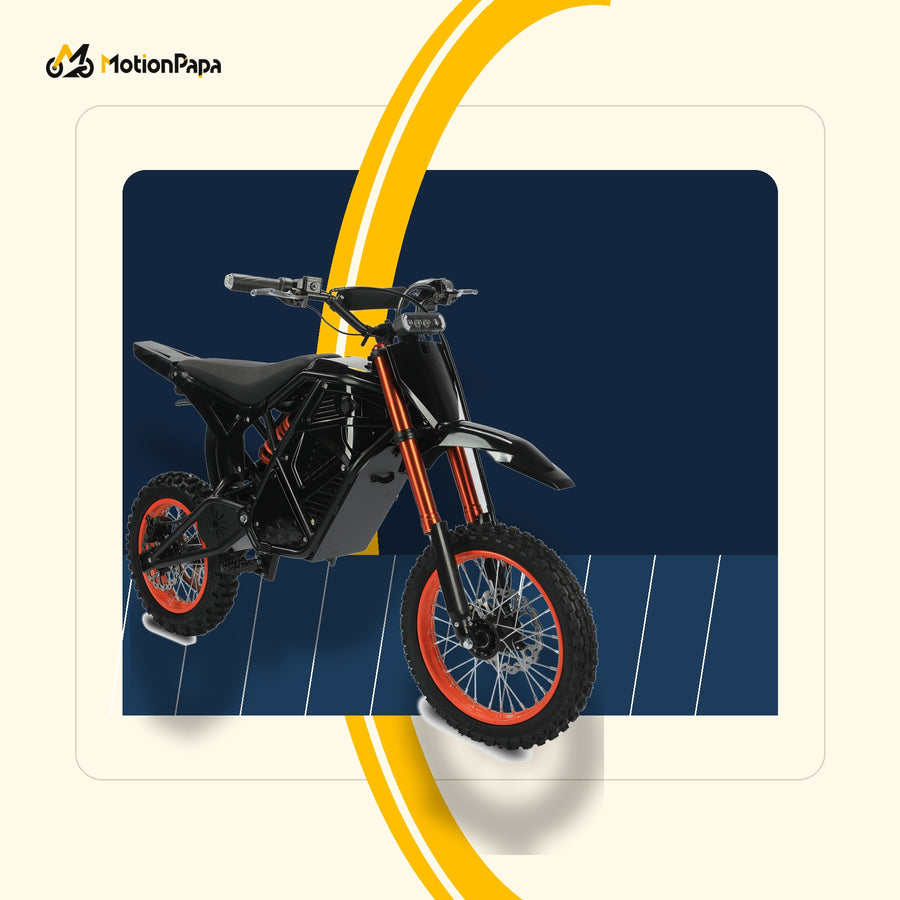
Choose a 14/12 electric dirt bike wheel setup when a more compact staggered format, simpler transport planning, and stronger verified ownership data fit your route. Consider 17/14 when the larger wheel diameters are a specific trail priority—not because larger numbers automatically make a machine better. The route, complete tire code, rider fit, and product record still decide the answer.
Last updated: September 5, 2026. We reviewed the live MotionPapa product records, native variants, metafields, prices, and Shopify images for Drogon D3 and Raptor B001. This is a specification-led ownership guide, not a matched ride test. MotionPapa has not supplied controlled handling, obstacle, traction, or braking results for these wheel setups.
What does 14/12 versus 17/14 actually describe?
In this comparison, 14/12 means a 14-inch front rim and 12-inch rear rim; 17/14 means a 17-inch front rim and 14-inch rear rim. That shorthand describes rim diameters, not the tire’s complete outer diameter, width, tread pattern, pressure, compound, or the bike’s final ground clearance.
The full codes matter. Michelin’s 2026 motorcycle tire-marking guide explains that a code such as 70/100-17 includes nominal section width, aspect ratio, and rim diameter. Read the whole marking rather than comparing only the last number.
Drogon D3PLUS lists 60/100-14 front and 80/100-12 rear tires. Drogon D3MX lists 70/100-17 front and 90/100-14 rear tires. Raptor B001 returns to 60/100-14 front and 80/100-12 rear. Those are verified product-record facts; they do not, alone, prove a universal handling outcome.
Who is each wheel-size route for—and not for?
The 14/12 route is for riders who want a compact staggered layout and can match it to a defined trail, transport method, storage position, and rider fit. It is not automatically lightweight: Raptor B001 lists 60 kg net weight, while D3PLUS lists 65 kg net and 83 kg gross package weight.
The 17/14 route is for a rider who has identified a concrete reason to prioritize larger rim diameters and has confirmed physical fit. It is not a shortcut around missing facts. The current MotionPapa record does not confirm D3MX net weight, gross weight, package dimensions, battery specification, or controlled clearance and handling measurements.
New off-highway riders should put training and route reading ahead of wheel-size ambition. The Motorcycle Safety Foundation’s 2024 off-highway practice guide emphasizes protective gear, pre-ride inspection, terrain awareness, and skills practice. A larger front rim cannot replace those fundamentals.
How do the verified MotionPapa setups compare?
| Decision factor | Drogon D3PLUS | Drogon D3MX | Raptor B001 |
|---|---|---|---|
| Wheel setup | 14 in front / 12 in rear | 17 in front / 14 in rear | 14 in front / 12 in rear |
| Full tire record | 60/100-14 front; 80/100-12 rear | 70/100-17 front; 90/100-14 rear | 60/100-14 front; 80/100-12 rear |
| Listed top speed | 75 km/h | 85 km/h | 55 km/h / 34 mph |
| Listed range | 70–80 km product-level record | 70–80 km product-level record | 50–60 km at 70 kg load under 35 km/h |
| Maximum load | 150 kg product-level record | 150 kg product-level record | 120 kg / 265 lb |
| Verified vehicle weight | 65 kg net; 83 kg gross package | Not confirmed in current record | 60 kg net; 65 kg gross package |
| Current variant price | $1,599 | $1,799 | $1,299 |
The table keeps unlike facts separate. Drogon’s 70–80 km range and 150 kg maximum load are product-level records shared across the current listing; they are not variant-specific test results. Raptor’s range includes stated conditions. Real range and speed can vary with rider, load, terrain, temperature, maintenance, and riding mode.
Price also does not isolate the value of wheel size. D3MX currently costs $200 more than D3PLUS, but the current listing also shows a different speed specification. Without matched motor, battery, weight, geometry, and test data for both variants, this article cannot attribute that price difference or any ride outcome to wheels alone.
What should you measure before choosing?
Start with rider fit: confirm that you can reach the controls, support the machine at a stop, and move it without relying on motor power. Then measure the transport and storage route. A wheel choice that suits the trail can still fail ownership if the complete machine does not fit the rack, vehicle, doorway, or floor space.
Next, describe the actual surface: hard-packed paths, ruts, loose soil, roots, rocks, gradients, and permitted route width. Larger rim diameter may be relevant to that plan, but the product records do not provide matched obstacle tests or outer tire diameters. Do not convert the 17/14 shorthand into an unsupported clearance promise.
Finally, check the complete tire sidewall and product documentation before replacement. The rim diameter must match, but width, aspect ratio, load and speed ratings, construction, clearance, and manufacturer fitment also matter. This works best as a compatibility check, not a mix-and-match invitation based on two headline numbers.
What are the important limitations and local-use boundaries?
This guide does not claim that 17/14 turns faster, grips better, clears every obstacle, or rides more comfortably. It also does not claim that 14/12 is easier for every beginner. MotionPapa has not published matched test results for those outcomes, and the current D3 record leaves battery details and D3MX ownership dimensions unconfirmed.
Before every ride, inspect the tires, controls, brakes, frame, cables, and visible damage. The U.S. Consumer Product Safety Commission’s 2026 micromobility safety guidance reinforces inspection, protective equipment, manufacturer limits, and local traffic rules. Dirt e-motos also require category-specific judgment beyond a general micromobility checklist.
Neither wheel size establishes public-road legality. California State Parks’ 2026 OHV guidance, for example, separates off-highway operation, registration, equipment, and limited highway situations. Your location may classify the same machine differently, so verify permitted areas, registration, licensing, insurance, equipment, and trail rules with the relevant authority.
Which wheel-size setup is the best fit?
Best-for verdict: choose 14/12 when you want the more compact wheel route and value the stronger current ownership record. Raptor B001 gives a fixed 14/12 path with verified 48 V 21 Ah battery, 60 kg net weight, and eight-hour charging record; D3PLUS gives 14/12 inside the two-variant Drogon family.
Choose Drogon D3MX only when 17/14 is a deliberate requirement and you are comfortable confirming the missing battery, weight, package, and fit details before purchase. Larger wheels are not a complete verdict. If those gaps affect transport or rider fit, D3PLUS or Raptor is the more evidence-complete decision today.
If you are still choosing the vehicle family rather than the wheel format, compare the MotionPapa Beasts Series and use the Electric Ride Buying Guide. The related load-and-vehicle-weight guide explains why maximum load and machine weight answer different questions.
Compare the two Drogon wheel setups
If the Drogon platform fits your off-highway plan, inspect the live images and choose the exact variant on the Drogon D3 product page. Pick D3PLUS for the 14/12 route; choose D3MX only when the 17/14 format solves a measured need and the remaining ownership facts are confirmed with MotionPapa before checkout.