An electric scooter is the clearer longer-route choice when you want a standing platform and can plan around a published range window. A street-style electric moto becomes the stronger candidate when seated geometry and a larger tire format are decisive—but range, local classification, registration, and permitted riding areas still need to be confirmed for the exact model.
Last updated: September 19, 2026. For this guide, we compared the live MotionPapa native product fields, motion_papa metafields, product images, collection context, and support language for the Hezzo Vision F6 and Shengmilo Photon S900. We did not road-test either vehicle, so listed range and charging time are not presented as observed outcomes.
Who should choose each longer-route format?
Choose a standing performance scooter when your route has predictable distance, you are comfortable standing for the trip, and the published range and charging window let you build a realistic buffer. This works best with ground-level storage or a roll-in parking route. The Vision F6 is 43 kg net, so the scooter category should never be mistaken for easy stair carrying.
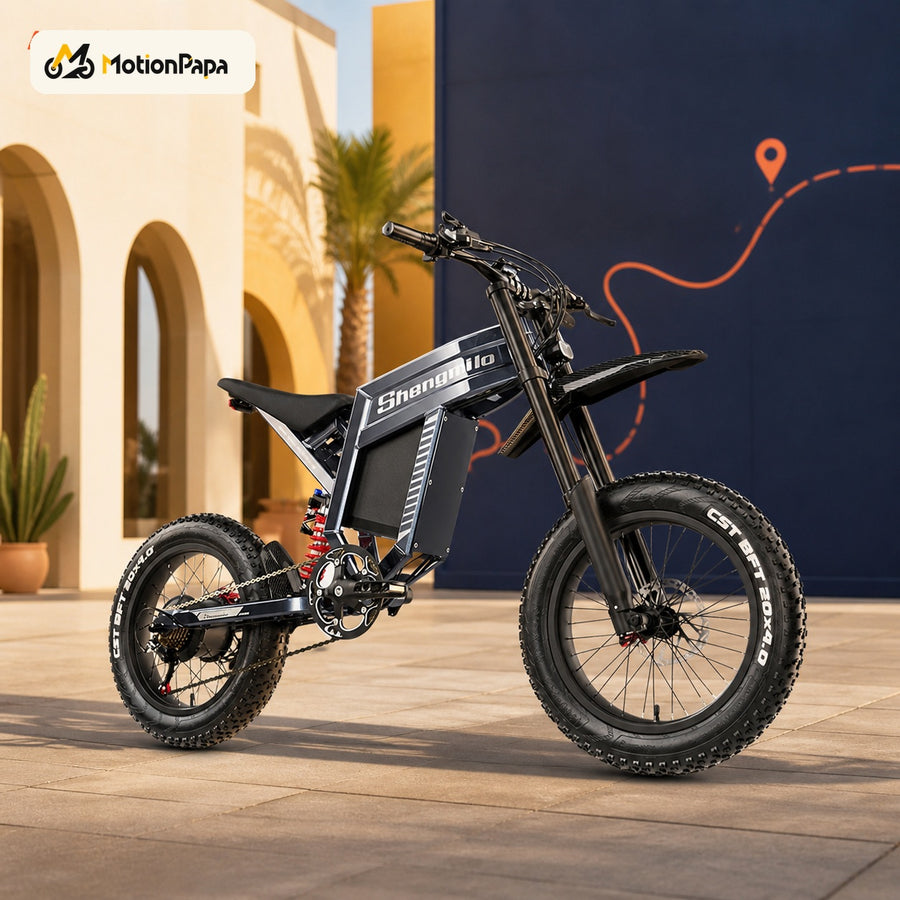
Choose a street-style e-moto when a seated riding position, 20 × 4.0 pneumatic tires, and motorcycle-style proportions fit the route better than a standing deck. The Photon S900 is 42 kg net and lists a 7–8 hour charging window, but its current MotionPapa record does not publish range or top speed. That missing route evidence matters more than category confidence.
What actually changes on a longer route?
Distance is only one part of the decision. There are four components: time on the vehicle, energy and recharge planning, storage at both ends, and the legal category where the ride will happen. A route can fit a battery estimate while failing on standing time, building access, destination parking, or public-road permission.
| Decision factor | Vision F6 performance scooter | Photon S900 street e-moto |
|---|---|---|
| Riding format | Standing electric-scooter platform | Seated street-style e-moto format |
| Verified battery | 60 V 23 Ah | 60 V 30 Ah lithium battery |
| Verified range | 50–60 km listed estimate | Not published in the current record |
| Listed charging time | Approximately 3–5 hours | 7–8 hours |
| Tire record | 10-inch off-road tires | 20 × 4.0 pneumatic tires |
| Net weight | 43 kg | 42 kg |
| Main unresolved check | Whether standing time and storage fit the complete route | Range, speed, classification, registration, and permitted-use checks |
Unlike a short errand, a longer route exposes weak assumptions. The difference between these two paths is not simply scooter versus moto. It is published route evidence versus an alternative riding format with important missing fields. Start with the route, then use the product category as one input rather than the answer.
What do the live Vision and Photon records verify?
The Hezzo Vision F6 product page verifies a 60 V 23 Ah battery, 3,200 W listed power, 10-inch off-road tires, a 150 kg maximum load, a 50–60 km listed range, a 60–70 km/h listed top-speed range, and approximately 3–5 hours of charging. Actual outcomes vary with rider, load, terrain, temperature, maintenance, battery condition, and riding mode.
The Shengmilo Photon S900 product page verifies a 60 V 30 Ah lithium battery, 1,500 W listed motor, 20 × 4.0 pneumatic tires, hydraulic disc brakes, 42 kg net weight, and a 7–8 hour charging record. It does not currently verify range, top speed, certification, registration status, or universal road legality.
Do not compare battery voltage or motor watts as if either number alone predicts the better longer route. Vehicle format, total mass, tires, terrain, speed, stops, weather, rider load, battery condition, and charging access all change the ownership decision. The key idea is to compare the complete routine, not the loudest specification.
How should charging and storage affect the choice?
A longer route should leave energy margin instead of treating the top of a listed range as a daily promise. Vision offers the clearer planning record because both range and charging time are published. Photon may fit a seated route, but its 7–8 hour charging window and missing range mean the buyer needs written clarification before building a daily schedule around it.
The U.S. Consumer Product Safety Commission’s 2025 micromobility charging guidance says to use the supplied charger, stay present while charging, follow manufacturer instructions, and unplug when charging is complete. The U.S. Environmental Protection Agency’s lithium-ion battery guidance recommends room-temperature storage and keeping end-of-life batteries out of household trash and curbside recycling.
Both vehicles need a realistic storage path. At 42–43 kg net, neither is a casual carry choice. Measure doors, ramps, lifts, turning space, parking footprint, and outlet access at home and destination. The current product records do not confirm removable batteries for either model, so this guide does not assume that charging can be separated from the complete vehicle.
How do local rules change the answer?
Do the legal check before using any performance claim to plan a public-road route. The label on a store collection is not a registration decision. Verify the exact vehicle, power and speed record, seat and wheel configuration, lighting and equipment, registration or licensing needs, insurance, helmet rules, age limits, and permitted riding areas with the relevant local authority.
The need for a local check is not theoretical. Current UK government guidance says privately owned e-scooters cannot be used on public roads, pavements, or parks, while approved rental trials follow a separate path. A 2026 European Parliament answer notes that on-road rules for personal mobility devices remain fragmented across member states.
In simple terms, a vehicle that fits the distance may still fail the route. MotionPapa does not guarantee public-road legality for either Vision or Photon. If public use is essential, obtain model-specific confirmation from the authority responsible for the exact place you will ride; do not rely on a product title, a seat, or a top-speed number as proof.
Which route is the best fit?
Best-for verdict: choose Vision F6 when you want a standing performance-scooter format, the live 50–60 km range estimate gives you enough buffer, the 3–5 hour charging window fits your schedule, and ground-level storage makes its 43 kg net weight workable. It is the primary recommendation for this article because the current record answers more of the longer-route planning questions.
Choose Photon S900 when seated geometry and 20 × 4.0 pneumatic tires are the deciding format, not because an e-moto label automatically means more range. Before committing, resolve the missing range, top-speed, certification, registration, and permitted-use facts. Compare the E-Scooters collection and E-Motos collection if the vehicle family is still open.
Use the Electric Ride Buying Guide to score route, terrain, storage, charging, and support before the model decision. For the broader family map, read Choose by Route, Not Noise. Boring can walk; the daily route still gets the final vote.
Start with the product that gives the route a measurable buffer
If a 50–60 km listed range, 3–5 hour charging window, 150 kg maximum load, and standing performance-scooter format fit your route, inspect the live images and current fields on the Hezzo Vision F6 product page. Keep a real-world distance margin and confirm local-use requirements before checkout.